

PAUSTI Graduation Ceremony 2026: A Celebration of Knowledge, Innovation and Service
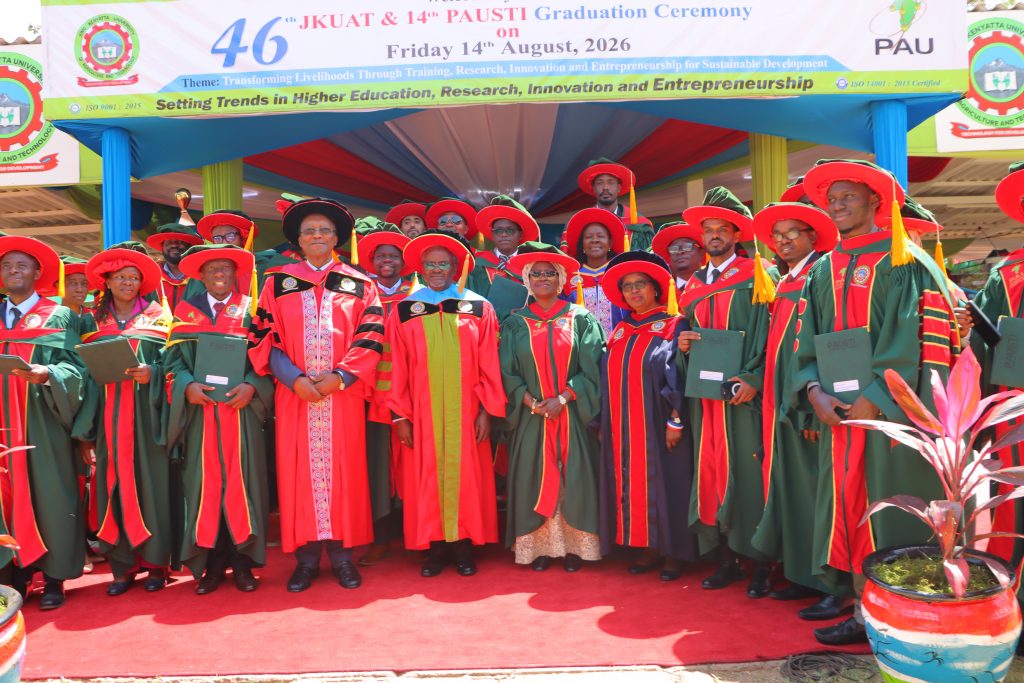
The joint graduation ceremony of Jomo Kenyatta University of Agriculture and Technology and the Pan African University Institute for Basic Sciences, Technology and Innovation was held on Friday, August 14, 2026. A total of 5,035 students graduated, among them 71 from PAUSTI, comprising 25 doctoral and 46 master’s degree holders drawn from 33 African countries. This diverse cohort reflects the Pan African University’s mission of fostering continental integration through advanced training, research and innovation.
Prof. Bolanle Idowu Akeredolu, Vice Rector for Academic and Student Affairs at the Pan African University, opened her message by urging graduates to embrace innovation and entrepreneurship as they step into the wider economy. She reminded them that their knowledge carries both opportunity and responsibility, and must be applied in service of society across Africa and beyond. “Your work must go beyond the university walls. Let it create enterprises, jobs and solutions that improve lives,” she said, underscoring the Pan African University’s commitment to connecting scholarship with measurable social and economic impact.
Prof. Victoria Wambui Ngumi, Vice Chancellor of JKUAT, expressed pride in hosting PAUSTI and reaffirmed the University’s dedication to providing the academic and institutional environment needed for the Institute’s success. She emphasized that the true value of graduates’ qualifications will be measured not only by personal accomplishments but by the problems they solve, the organizations they strengthen and the opportunities they create for others. “Let integrity guide your decisions, service shape your leadership and the relevance of your work remain the enduring measure of your education,” she urged.
Prof. Ngumi also highlighted JKUAT’s efforts to harness partnerships that transform research into solutions. She cited contributions to Kenya’s National AI Strategy, cleaner maritime technologies, improved potato production and dairy market linkages as examples of research with tangible societal impact. She announced new academic programmes aligned with future needs, including degrees in Communication and Marketing, Revenue Administration and Technology, Chemical Engineering and Nautical Science. She noted that JKUAT is embedding outcome‑based education in engineering programmes as part of accreditation under the Washington Accord, enhancing global recognition of its graduates.
Prof. Losenge Turoop, Director of PAUSTI, celebrated the graduating class as a new generation of African scientists, researchers and innovators. He highlighted PAUSTI’s mandate to provide rigorous postgraduate education and foster interdisciplinary research in engineering, biotechnology, data science and artificial intelligence. Prof. Turoop underscored the importance of bridging the gap between research and practical application, pointing to the PAUSTI Incubation Centre of Excellence as a platform where students refine ideas, build entrepreneurial capacity and translate research into innovations of real value.
He also invited graduates to participate in the upcoming third Pan African University International Conference in November 2026, which will focus on harnessing research and innovation for water, food security and sanitation. Closely aligned with the African Union’s Theme of the Year, the conference will bring together scholars, policymakers, industry leaders and innovators to exchange knowledge and build collaborations. Prof. Turoop urged graduates to remain connected to the Pan African University Alumni Association and the PAUSTI Alumni Chapter, continuing to collaborate and contribute to Africa’s transformation.
Hon. Julius Migos Ogamba, Cabinet Secretary for Education, concluded the ceremony’s official messages with a strong call to action. Speaking on behalf of the Government and people of Kenya, he congratulated the Class of 2026 and emphasized that universities must accelerate the commercialization of research and innovation. “Our institutions of higher learning must deliberately scale up innovations and translate them into viable products, services and enterprises,” he said, noting that higher education must demonstrate its economic value by creating jobs and practical solutions to Africa’s challenges.
The Cabinet Secretary further urged universities to prepare for the transition to Competency‑Based Education, with the first cohort expected to enter universities in 2029. He stressed that graduates must be equipped with skills that match emerging national and global needs, and encouraged them to use their expertise to strengthen communities and contribute to the Africa envisioned in Agenda 2063.
Together, the Vice Rector, Vice Chancellor, Director and Cabinet Secretary painted a vision of higher education as a driver of Africa’s transformation. Their messages converged on a common theme: universities must not only generate knowledge but also ensure its translation into technologies, enterprises and policies that deliver tangible benefits.
The graduation ceremony concluded with a shared message of hope, responsibility and continental solidarity. Graduates were urged to remain curious, act with integrity and use their knowledge to strengthen institutions, create opportunities and contribute to the Africa We Want.